
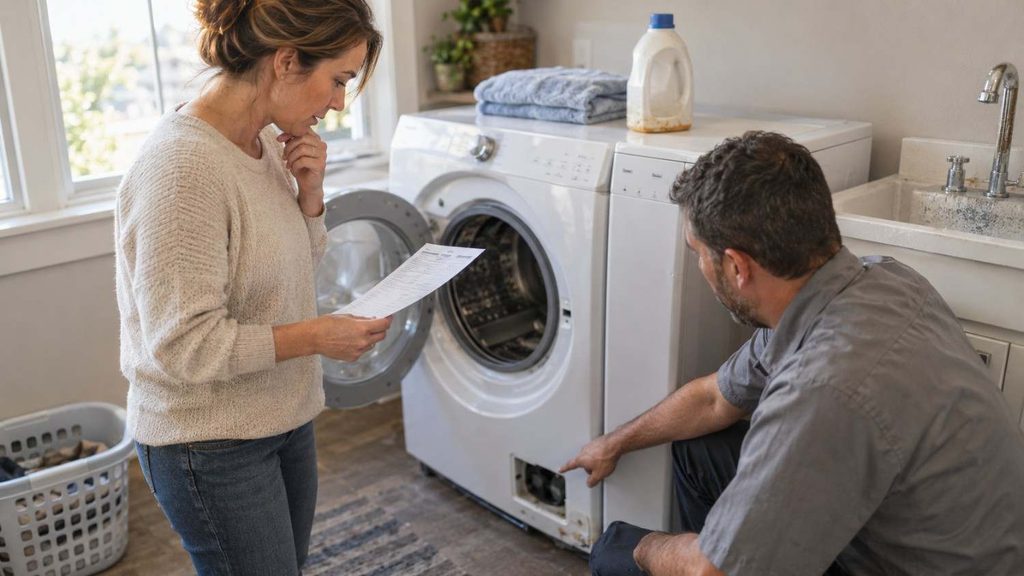
Your washer stops mid-cycle, leaves a puddle, or refuses to spin. Now you face a choice: pay for a repair or buy a new machine. Most homeowners guess, and guessing gets expensive. A repair that costs too much wastes money, and a replacement you did not need does the same. This guide gives you real numbers, a simple rule, and clear signs so you can decide with confidence.
The Real Cost of Guessing Wrong
Replace too early and you buy a machine you could have fixed for a fraction of the price. Replace too late and you pay for a repair, then watch a second one follow a few months later.
Three facts settle most cases: the washer’s age, the repair quote, and the price of a comparable new machine. The sections below show you how to find each one.
Before You Spend a Dollar: Free Checks That Rule Out Simple Problems
Many washer failures turn out to be small problems. A few free checks can save you a service call.
Simple Checks That Fix Many “Dead Washer” Problems
Confirm the washer has power, the breaker has not tripped, and the lid or door closes fully. A faulty latch stops the cycle. Make sure the water faucets are open and the hoses are not kinked.
Check the inlet hose screens for debris or mineral buildup, clean the drain filter if your model has one, and make sure the machine sits level. Our list of essential tools every homeowner should have covers what you need for these checks.
When a DIY Check Ends and a Technician Should Take Over
Stop if you smell burning, see sparks, or find water near electrical parts. Shut off power and water, then call a technician.
Wiring, control boards, and drum repairs belong to a professional. A wrong move can turn a small repair into a costly one.
How Long Washers Really Last
Age is the first number in the repair-or-replace decision. Knowing what to expect tells you how much life your washer has left.
Average Washer Lifespan: What the Data Says
Consumer Reports puts a washer’s life expectancy at close to 10 years on average, though published studies range from about 5 to 15 years. Our appliance lifespan guide shows what to expect from each major appliance.
Use 10 years as your benchmark. Past about 8 years, a major repair deserves extra scrutiny.
Top-Load vs. Front-Load: Reliability and Lifespan Differences
Each design has its own weak spots. A repair-cost guide notes that front-loaders have more parts to wear, including a door lock, rubber door seal, suspension, and bearings.
Top-loaders skip the door seal, though they still rely on pumps, belts, and lid switches. Knowing your washer’s usual weak spots helps you judge whether a quote makes sense.
How Temecula’s Hard Water and Heavy Use Affect Washer Life
Rancho California Water District reports Temecula’s water hardness at roughly 10.7 grains per gallon, which it classifies as hard. Mineral scale can build up in hoses, valves, and pumps over time. Our guide on how hard water damages appliances in the Inland Empire explains what to watch for.
Heavy use adds wear too, since more loads put more cycles on the same parts.
What Washer Repairs Actually Cost in 2026
A quote means little until you know the usual price range. Local prices vary, so treat these national figures as a baseline and compare them with a written quote.
Average Washer Repair Cost and Typical Price Range
Angi’s 2026 data puts the average washer repair at $180 to $250, with about $220 typical. Smaller jobs, like replacing a hose or door latch, cost less than that.
The final price depends on the part, the washer type, and the technician’s labor.
Repair Costs by Problem, From Drain Pumps to Control Boards
Angi lists control board repairs at about $200 to $500 and motor repairs at about $250 to $700. Drum, bearing, and transmission work takes extra labor because the technician has to take much of the machine apart.
Those bigger jobs can climb to $700 or more. Use these ranges to check whether your quote sounds fair.
Why Front-Load and Smart Washers Often Cost More to Fix
Front-load washers often cost more to fix because of the door lock, seal, suspension, and bearings, and they take more time to open up. Smart models add electronics that can raise the bill further.
Our look at whether smart appliances break down more covers what 2026 data shows.
What a New Washer Really Costs Today
A repair quote only makes sense next to the price of a comparable new washer. Here is what a replacement costs.
New Washer Price Ranges by Type
Consumer Reports, using OpenBrand data from Best Buy, Home Depot, and Lowe’s, found median prices from March 2025 to February 2026. Front-loaders sat at $929, top-load agitators at $748, and high-efficiency top-loaders at $798.
Budget top-loaders start around $380.
Hidden Costs: Delivery, Installation, Hoses, and Haul-Away
Delivery, installation, and haul-away can add to the sticker price, and retailers set their own fees. Haul-away is free on some orders and around $30 at others, and installation can add $100 or more depending on your hookups.
Ask for a total price in writing before you compare it with a repair quote.
How Washer Prices Have Moved and What That Means for Waiting
Consumer Reports notes that front-loader prices have been creeping up in recent years. Prices change often, so check current listings before you decide.
Retailers also tend to scale back promotions after winter holiday sales and before major sales like Memorial Day, so timing can matter.
The 50 Percent Rule and Other Math That Settles the Decision
A simple formula removes most of the guesswork. Add age and repair history, and the answer usually becomes clear.
How to Apply the 50 Percent Rule Step by Step
The 50 percent rule is a widely used rule of thumb. Divide the repair quote by the price of a comparable new washer, and if the answer is above 50 percent, replacement usually makes more sense.
For example, a $400 repair on a $700 washer equals about 57 percent. That points toward replacement.
Why Age and Repair History Matter as Much as the Quote
The rule works best alongside age. Consumer Reports offers a useful contrast: a seven-year-old washer that cost $650 and runs seven loads a week points toward replacement, while a three-year-old $1,000 washer points toward repair.
Count recent repairs too. Two or three significant repairs in a short time suggest more failures ahead.
Three Worked Examples With Real-World Numbers
These examples use sample prices. A $220 drain pump repair on an $800 washer that is four years old equals 28 percent, so repair it.
A $450 control board on a $900 washer that is seven years old equals 50 percent, so weigh its repair history. A $500 bearing repair on a $700 washer that is eleven years old equals 71 percent, so replace it.
Signs Your Washer Is Worth Repairing
Some problems are cheap to fix and leave you with years of reliable use. These signs favor repair.
Common Fixes That Usually Pay Off
Drain pumps, lid switches, door latches, water inlet valves, and hoses are typically smaller jobs that cost far less than a new washer. A musty smell often points to buildup, not a dying machine. Our guide on fixing a musty washing machine shows how to clear it.
When a Younger Machine Deserves a Repair First
If your washer is under about 8 years old and the quote stays below the 50 percent line, repair it. Consumer Reports’ 2025 member survey found that only 13 percent of washers broke down in years two through five, so an early failure is relatively uncommon.
Check your warranty first. Most washer warranties last a year, though some brands offer longer coverage on certain parts.
How California’s Right to Repair Law Helps With Parts Availability
California’s Right to Repair Act, SB 244, took effect July 1, 2024. It requires manufacturers to provide parts, tools, and documentation for at least seven years after a model’s last manufacture date. That applies to products with a wholesale price of $100 or more, which covers most major appliances.
The law covers products manufactured on or after July 1, 2021 and sold or used in California on or after that date. If your washer was made before then, the law does not cover it.
Signs It’s Time to Replace Your Washer
Other problems signal that repair money would be wasted. Watch for these warning signs.
Age Red Flags: 10 Years and Counting
A washer past 10 years old that needs a major repair is usually a poor investment, since other parts are close to wearing out too. Most repair guides treat this as a clear signal to replace.
Between 8 and 10 years, weigh the quote against the 50 percent rule and the repair history.
Failures That Usually Signal the End
Tub or drum damage, failed bearings, and transmission failure often cost more than they are worth on an older machine. A failed control board on an aging washer also calls for caution, since the repair is expensive and other parts are tired.
Repeat Repairs, Leaks, and Safety Concerns
A second or third repair in a short span signals a machine on its way out. Persistent leaks, burning smells, or electrical problems add safety risk.
If water is spreading, our guide on what to do in the first hour of an appliance emergency walks you through shutting off water and power.
Beyond the Repair Quote: Energy, Water, and Long-Term Savings
A new washer can also lower your utility bills. The savings are real, but they are modest.
What ENERGY STAR Certified Washers Can Save
ENERGY STAR says certified washers use about 20 percent less energy and about 30 percent less water than regular models. The agency estimates they can save about $530 in energy costs over their lifetime.
Our guide to understanding ENERGY STAR labels in plain language explains how to read the ratings.
Does Efficiency Alone Justify Replacing a Working Washer?
Usually not. Divide that $530 estimate by a 10-year life and you get roughly $50 a year.
ENERGY STAR also says about 90 percent of washer energy goes to heating water, so washing in cold water saves money on any machine. Aging appliances can cost more to run, as we explain in how old appliances secretly raise your utility bills.
Smart Questions to Ask Before You Approve a Repair
A few questions protect your wallet. Ask them before you say yes to any repair.
Ask for a Written, Itemized Quote and Clear Diagnostic Terms
Ask what the diagnostic fee covers and whether it applies toward the repair. Request a written quote that lists parts, labor, and any extra fees.
A clear quote lets you run the 50 percent rule with confidence.
Ask About Parts, Warranty, and When a Second Opinion Makes Sense
Ask whether the shop uses new or used parts. California’s Right to Repair Act requires independent repair shops to disclose used or non-manufacturer parts before a repair. Also ask how long the repair itself is covered.
Get a second opinion if the quote sits near the 50 percent line. If your washer broke early, review these common warranty gaps before you pay.
If You Decide to Replace: How to Buy the Right Washer
If replacement wins, a smart purchase keeps your next washer running longer. A few choices make the biggest difference.
Choosing Between Front-Load, Top-Load Agitator, and High-Efficiency Top-Load
Front-loaders generally use less water per cycle, but they cost more, at a median of $929. Top-load agitators cost less, at $748, and suit tight budgets.
High-efficiency top-loaders land in the middle at $798.
Matching Capacity and Features to Your Household
Choose a drum size that fits your weekly laundry volume, since overloading can strain the machine and leave clothes less clean. Large or multi-generational households may need more capacity. Our guide on appliance care for multi-generational households explains how to plan for heavy use.
Skip features you will not use. Extra electronics give you more parts that can fail.
Timing Your Purchase, Finding Rebates, and Disposing of the Old Washer
Plan around major sale events, since retailers often pull back promotions in between. Use ENERGY STAR’s rebate finder and check with your utility for incentives on certified models.
Ask about haul-away when you order, since policies range from free to about $30.
Conclusion: A Clear Decision Beats a Rushed One
Deciding between repair and replacement gets easier when you know your washer’s age, the repair quote, and the price of a new machine. Run the 50 percent rule, weigh the repair history, and rule out the free fixes first.
If you want a second opinion on your washer, Appliance Repair Southern California can take a look and give you a straight answer. You can also reach out here anytime.
FAQs
Is it worth repairing a washing machine that’s 10 years old?
Only if the fix is small and the 50 percent math works. A 10-year-old washer sits at the average life expectancy, so a major repair is usually a poor investment.
How much does it cost to repair a washing machine?
Angi’s 2026 data puts the average repair at $180 to $250, with about $220 typical. Control board repairs run about $200 to $500, and motor repairs about $250 to $700.
What is the 50 percent rule for washing machines?
If a repair costs more than half the price of a comparable new washer, replacement usually makes more financial sense. Factor in age and repair history too.
How long should a washing machine last?
Consumer Reports puts average life expectancy at close to 10 years. Published studies range from about 5 to 15 years, depending on use, brand, and care.
Why is my washing machine not draining or spinning?
Common causes include a clogged drain filter or hose, a failed drain pump, an unbalanced load, or a faulty lid switch or door latch. Check the filter, hoses, and load first. If the problem continues, call a technician.
Will a new ENERGY STAR washer lower my utility bills?
Yes, somewhat. Certified washers use about 20 percent less energy and 30 percent less water than regular models. ENERGY STAR estimates that saves about $530 in energy over the machine’s life.

Eric Adams
Eric is the lead repair expert at Appliance Repair Southern California. With 17+ years of experience, he has built a reputation for providing fast, reliable, and high-quality repair services across Southern California. His expertise covers a wide range of appliances, including refrigerators, ovens, dishwashers, and washing machines. Eric is committed to exceptional customer service and ensuring every repair is done right the first time. Under his leadership, Appliance Repair Southern California continues to be a trusted name in the industry.